
One of the first principles of capital allocation is also one of the simplest.
Yet it remains widely misunderstood.
Albert Einstein is often credited with describing compound interest as one of the most powerful forces in the universe. Whether or not he used those exact words, the insight remains correct: compounding quietly governs the accumulation of wealth, knowledge, and capability over long periods of time.
It is slow at first.
Almost invisible in the early years.
But given enough time, it becomes overwhelming.
Understanding this principle — and structuring one’s life around it — is one of the foundations of enduring prosperity.
What Compounding Actually Is
Compounding occurs when returns generate additional returns.
Instead of earning a return only on your original capital, you begin to earn returns on previous returns as well.
Mathematically, this produces exponential growth.
Psychologically, however, it rarely feels that way in the early years.
The early phase of compounding is quiet.
The later phase is explosive.
Most people encounter the quiet phase and underestimate what is actually occurring.
Time: The First Multiplier
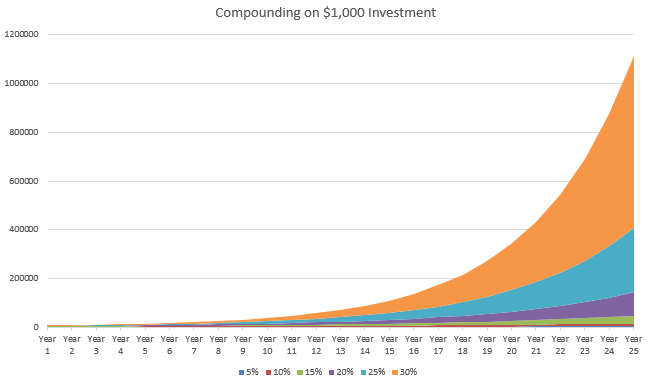
The first lesson from the charts is simple:
Time is the most powerful driver of compounding.
An investor who begins compounding early has an enormous structural advantage over one who begins later — even if the later investor achieves slightly higher annual returns.
This is because the compounding process itself requires time to accelerate.
In the early years the growth appears modest.
But after a decade or two the curve begins to steepen dramatically.
The investor who starts earlier benefits from the long tail of exponential growth.
Those who delay often underestimate how difficult it is to recover that lost time.
Small Differences in Returns Become Large Differences in Outcomes
The second lesson is equally important.
At first glance the difference between investment returns of, say, 10% and 15% per annum does not appear dramatic.
Yet over long periods of time those seemingly modest differences compound into enormous gaps in final wealth.
An initial investment of $1,000 compounded at 10% p.a. for 10 years turns into $2,594; whereas compounding at 15% p.a. results in $4,046 (almost double).
Over a longer period, even a few percentage points of additional annual return can multiply outcomes several times over. At year 25, $1,000 compounded at 10% p.a. becomes $10,835 (almost 11x the initial investment); at 15% it becomes $32,919 (33x)!
Higher rates of growth (extremely rare over such periods) give breathtaking results.
This is one reason why disciplined capital allocation matters so much.
The goal is not simply to achieve positive returns.
It is to achieve superior compounding over long periods of time while protecting capital from permanent loss.
Small edges, consistently applied, become decisive over decades.
Well Known High Compounders
If an investor simply held the stock of the following well known companies for 25 years (from January 2001 to the December 2025) following approx compounded annual growth rates (CAGR) will have been earned:
Berkshire Hathaway 9.97%
Microsoft 13.08%
American Express 9.86%
Why Compounding Is Often Interrupted
If compounding is so powerful, why do so few investors benefit from it fully?
Because the process is fragile.
Compounding is frequently interrupted by four common frictions:
- excessive leverage
- taxation
- structural inefficiencies (e.g. transaction costs)
- behavioural instability & short-term decision making
These frictions repeatedly reset the compounding process.
Capital is lost.
Investments are liquidated prematurely.
Taxes are triggered unnecessarily.
The compounding engine stops and must begin again.
The most successful long-horizon investors focus not only on finding good opportunities but also on removing these frictions.
(We will be addressing these frictions in more detail in future posts.)
Compounding Is Not Only Financial
While the charts illustrate financial capital, the principle extends much further.
Compounding also governs:
- knowledge
- relationships
- reputation
- health
- judgment
Small improvements, sustained consistently over long periods of time, accumulate into extraordinary outcomes.
This is one reason the Wealth & Wellness Code integrates capital allocation with structure and disciplined practice.
Compounding is not a single-domain phenomenon.
It is a universal principle of long-horizon performance.
The Long Game
The lesson is ultimately straightforward.
Compounding rewards:
- patience
- discipline
- intelligent structure
- long-time horizons
It punishes impatience and short-term thinking.
Those who understand this principle organise their lives and their capital differently.
They play the long game.
And over time, the mathematics of compounding begins to work quietly — but powerfully — in their favour.
This publication is operated by Polygon Cogent Pty Limited (the “Company”). All content is published on behalf of the company and is provided for general educational purposes and is not financial advice.